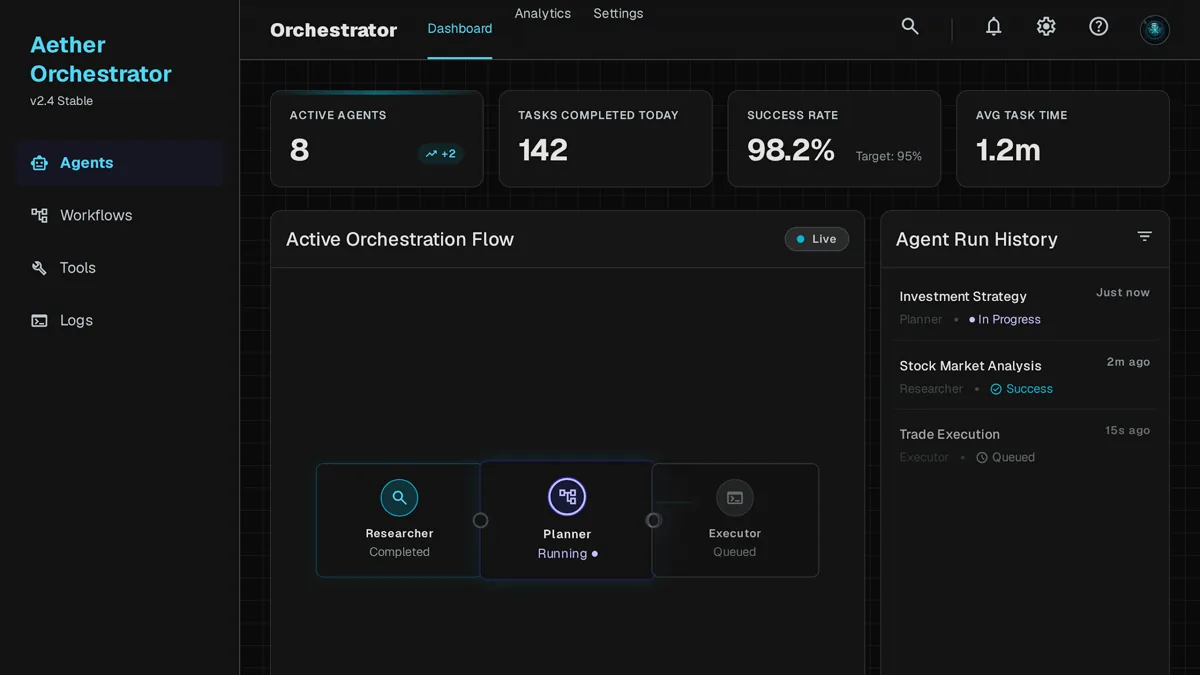
A single chatbot answers questions. An agentic system completes a task — it researches, plans, executes, and checks its own work, with each step handled by a specialized agent. We build agent workflows around the actual process your business needs automated end to end.

No-code agent builders get a demo running fast but struggle once a workflow needs real tool access and reliability.
Agents take an action end to end — pulling data, making a decision, executing a step — instead of just producing an answer.
A Researcher gathers information, a Planner sequences the work, an Executor carries it out — each doing one job well.
Agents call your actual APIs and systems, not a sandboxed demo environment.
We build in human approval at the steps where a mistake would be costly, and full autonomy where it wouldn't.
The agent graph mirrors how your business actually gets the task done.
A canvas view shows which agent is doing what, so a stuck or failing step is obvious, not hidden in logs.
The orchestration layer that keeps multiple agents coordinated instead of stepping on each other.
Coordinates Researcher, Planner, Executor, and other roles so each handles its part of the task in order.
Agents can query your databases, call external APIs, and take real actions in your systems.
A live view of the agent graph, showing progress and where a task currently stands.
Pauses for approval at steps you define, instead of running fully autonomous by default.
Agents retry or escalate failed steps instead of silently giving up mid-task.
A record of every decision and action each agent took, for review after the fact.
No-code builders are good for prototyping a single conversational flow, but they hit limits fast on real tool access, error handling, and coordinating multiple agents on a shared task. A custom build handles the orchestration and integrations those tools aren't designed for.
No. A chatbot answers a question. An agentic system carries out a multi-step task — researching, deciding, executing, verifying — often without a person driving each step.
We build in checkpoints at the steps where an error would be costly, so a human reviews before anything irreversible happens. Lower-risk steps run autonomously.
A focused workflow with two or three agents handling one well-defined task typically takes 4-8 weeks, depending on how many systems it needs to integrate with.
Tell us what end-to-end task you want automated — we'll scope which agents it actually needs.