Smerdoff
Smerdoff / Solutions

Custom Applicant Tracking System Development

Off-the-shelf ATS platforms bill per seat and lock your hiring workflow into their pipeline stages, their scorecards, their integrations. We build an ATS around how your recruiters and hiring managers actually run requisitions — with no per-recruiter tax.

Hiring PipelineCandidate CardsInterview SchedulingScorecardsReporting
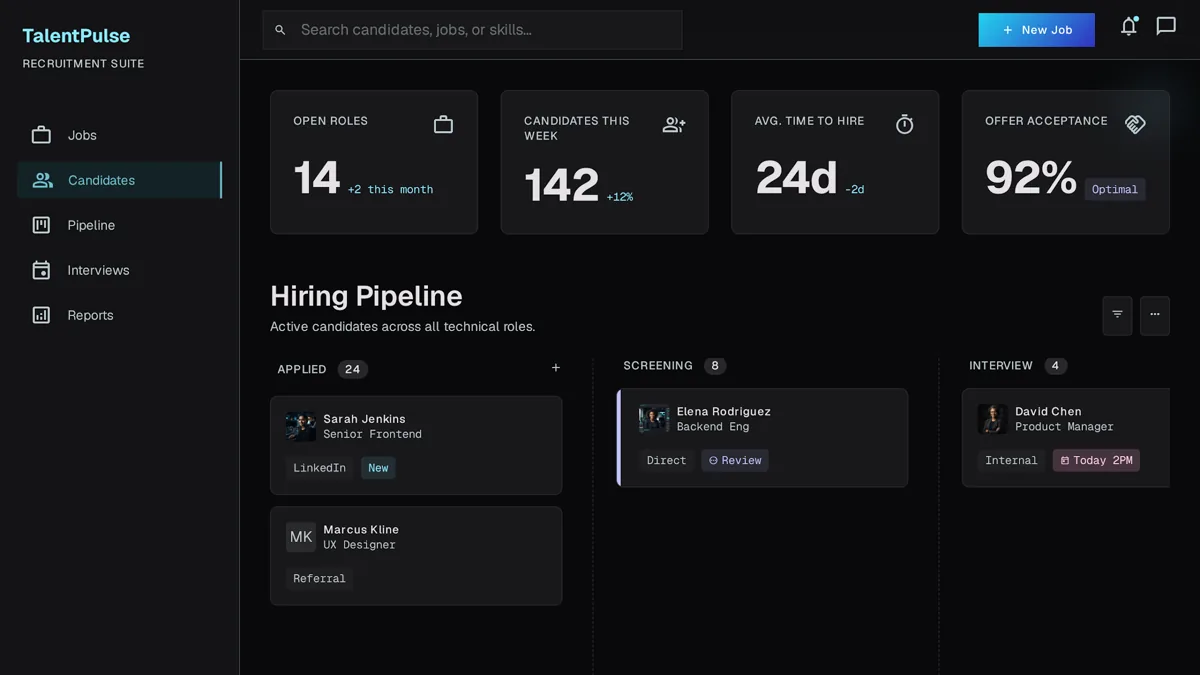
Custom applicant tracking system showing a Kanban hiring pipeline with candidate cards across Applied, Screening, Interview, Offer, and Hired stages
10–30%
of a full build is what a lean first version typically costs — validate before you commit
MVP cost research
9.4 hrs
saved per employee each week just by connecting the tools a business already uses
Zapier

Why recruiting teams outgrow off-the-shelf ATS tools

Generic ATS platforms work for standard hiring — until your pipeline stages, approval chains, or client reporting stop fitting their fixed structure.

Pipeline stages that match your process

Custom stages, sub-statuses, and approval gates modeled on how each department actually hires, not a fixed five-stage template.

No per-recruiter pricing

Add hiring managers, interviewers, and recruiters without a per-seat bill climbing every quarter.

One system for internal and client-facing hiring

Staffing agencies and internal TA teams both get a system that reflects their reporting lines, not a workaround.

Faster time-to-fill

Automated reminders, interview scheduling, and stage-aging alerts keep requisitions from stalling in someone's inbox.

Data you actually own

Candidate history, sourcing data, and hiring metrics live in your database, not locked behind a vendor's export limits.

Built-in compliance

EEOC reporting fields, audit trails, and retention rules built to your policy instead of retrofitted onto a generic form.

What goes into a custom applicant tracking system

We build the modules recruiting and hiring teams actually use day to day.

Kanban hiring pipeline

Drag-and-drop pipeline with custom stages — Applied, Screening, Interview, Offer, Hired — configurable per requisition or department.

Candidate cards

Resume, contact info, source, scorecards, and interview notes in one card recruiters can scan at a glance.

Resume parsing and search

Automatic resume parsing on submission plus full-text and boolean search across your candidate database.

Interview scheduling

Interviewer availability, self-scheduling links, and calendar sync so scheduling doesn't happen over email threads.

Job board and career site integration

Postings sync to your career page and job boards, with applications flowing straight into the pipeline.

Hiring analytics

Time-to-fill, source-of-hire, pipeline conversion, and recruiter load reporting without exporting to a spreadsheet.

FAQ

Mainstream ATS platforms are solid, mature products — for a standard corporate hiring process they cover most of what you need out of the box. A custom ATS makes sense when you're a staffing agency with client-specific pipelines, need deep integration with an internal HRIS or product, or want to avoid per-seat costs as your recruiting team scales.

Yes. We build direct integrations so a hired candidate flows into onboarding and payroll without re-entering data, which is one of the more common reasons teams move off a generic ATS.

Yes — each requisition or client can have its own pipeline stages, required scorecards, and approval steps, configured without engineering involvement after the initial build.

We build the required demographic data collection, retention periods, and audit logging into the system from the start, matched to your specific compliance obligations rather than a one-size-fits-all form.

A focused MVP — pipeline, candidate cards, and interview scheduling — usually takes 6-8 weeks, with analytics and integrations following in a second phase.

Related

Get a free estimate for your applicant tracking system

Tell us about your hiring stages, team size, and existing HR tools — we'll scope an ATS that fits how you actually recruit.