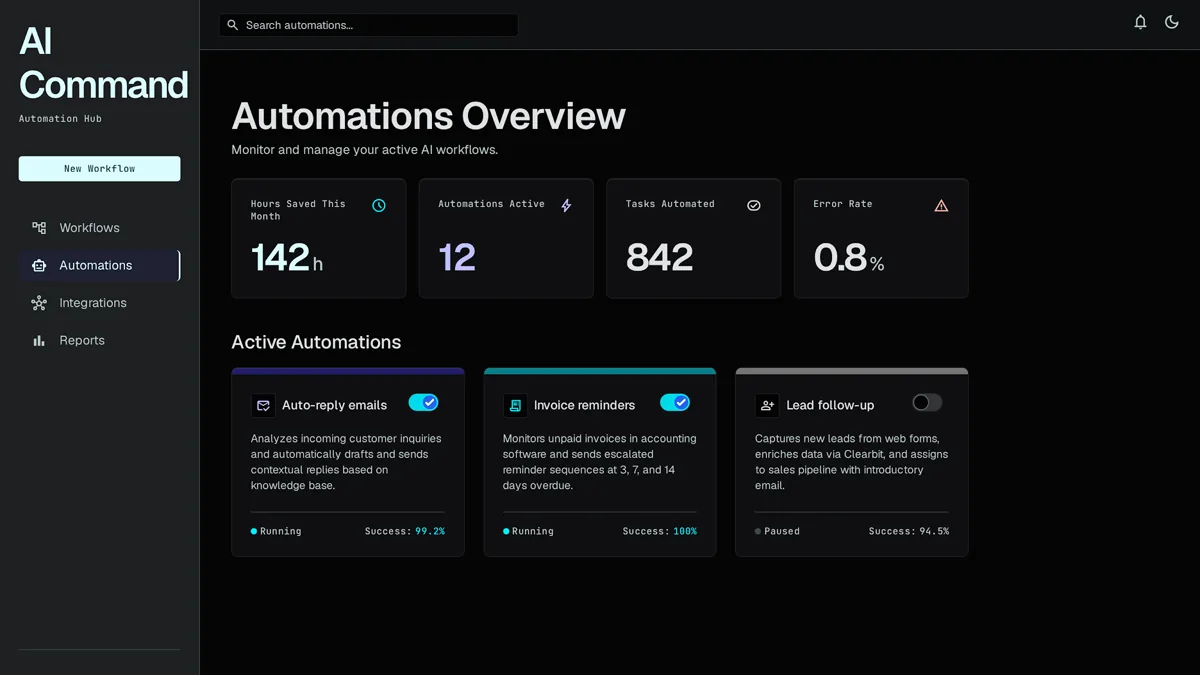
Most small businesses don't need an AI strategy. They need three specific manual processes — invoice entry, follow-up emails, appointment reminders — to stop eating up someone's afternoon. We automate the actual bottlenecks, built to fit how your team already works.

Not every process is worth automating. These are the ones that usually are.
We start by identifying which manual task actually costs the most hours, not by automating whatever's easiest.
A multi-step no-code workflow breaks the moment one connector changes. Custom automation is built to handle edge cases directly.
No-code automation tools charge per task run. At real volume that adds up fast — custom automation doesn't have a usage meter.
Built around your existing invoicing, CRM, or scheduling tools instead of asking you to switch platforms.
Real processes have edge cases. We build for the messy 20%, not just the clean 80%.
The automation is your code, not a rented workflow that disappears if you cancel a subscription.
Toggle on the ones that match where your team's time actually goes.
Extracts line items and totals from incoming invoices and enters them into your accounting system automatically.
Sends timed follow-ups to leads, unpaid invoices, or no-show appointments without a person triggering each one.
AI-assisted booking that checks availability and confirms appointments without back-and-forth emails.
Reads and routes incoming forms, applications, or intake documents to the right person or system.
Sorts incoming emails or messages by topic and urgency so nothing sits in a shared inbox unanswered.
Turns raw data from your existing tools into a plain-language weekly summary instead of a dashboard nobody opens.
For a single simple trigger-action workflow, a no-code tool is genuinely the right call and cheaper to start. It gets expensive and brittle once you need conditional logic, error handling, or high task volume — that's when custom automation costs less over a year and breaks less often.
No. We build automations that plug into your existing invoicing, CRM, or scheduling tools rather than requiring a platform switch.
We ask where your team actually spends repetitive time, then automate that first. It's usually invoice entry, follow-ups, or scheduling — not whatever looks impressive in a demo.
A single focused automation, like invoice processing or appointment reminders, usually launches in 4-6 weeks.
Tell us which manual process takes up the most time, and we'll scope a focused automation around it.