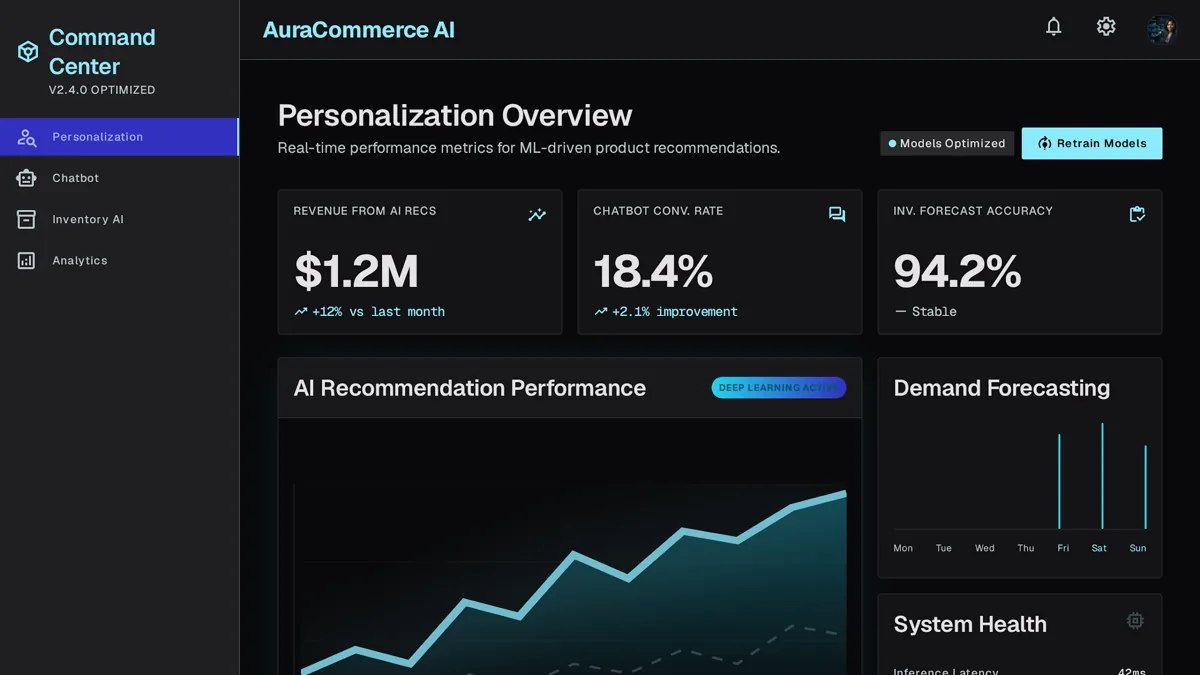
Generic recommendation widgets and forecasting add-ons work off someone else's model, trained on someone else's catalog. We build AI around your actual product data, traffic patterns, and margins — from personalization on the storefront to demand forecasting in the warehouse.

App-store widgets bolt AI onto your storefront without understanding your catalog. A custom build ties recommendations, support, and inventory to the same data.
Personalization models learn from your actual products, inventory levels, and margins — not a generic 'customers also bought' rule.
The AI chatbot answers from your live order, shipping, and return data instead of a static FAQ script.
Demand forecasting reads your real sales history and seasonality, so purchasing decisions aren't a spreadsheet guess.
Recommendations, chatbot, and forecasting share the same product and order data instead of syncing across separate apps.
Track recommendation-driven revenue, chatbot conversion, and forecast accuracy in one dashboard instead of three vendor reports.
Own the model and the infrastructure, so growth in SKUs or sessions doesn't trigger a pricing tier upgrade.
We build the modules that move revenue for your store — not a bloated suite you'll never configure.
Personalized cross-sell and upsell placements trained on your catalog and customer behavior.
Handles product questions, order status, and returns using your live store data.
Predicts SKU-level demand from sales history, seasonality, and promotions to guide purchasing.
Flags at-risk stockouts and overstock before they hit revenue or tie up cash.
One view across personalization, chatbot, and inventory AI with the KPIs that matter to the business.
Revenue from AI recommendations, chatbot conversion rate, and forecast accuracy tracked over time.
Yes. Product recommendations and personalization directly influence what customers add to cart, and we track that as a measurable revenue line — not just a support-ticket deflection metric.
We size the model to your data. A smaller catalog with a shorter sales history uses simpler seasonal and trend-based forecasting rather than a deep model that needs years of data to be accurate.
For stores whose catalog, promotions, or order logic don't fit an off-the-shelf app's assumptions, a custom build removes the workarounds and connects directly to your store's real data.
Subscription plug-ins cost less to start but charge more as your traffic or catalog grows and cap what you can customize. A custom build costs more upfront but has no usage-based fees and grows with features you request, not the vendor's roadmap.
Tell us about your catalog, traffic, and current stack — we'll scope AI that ties into it, not a plug-in you have to work around.