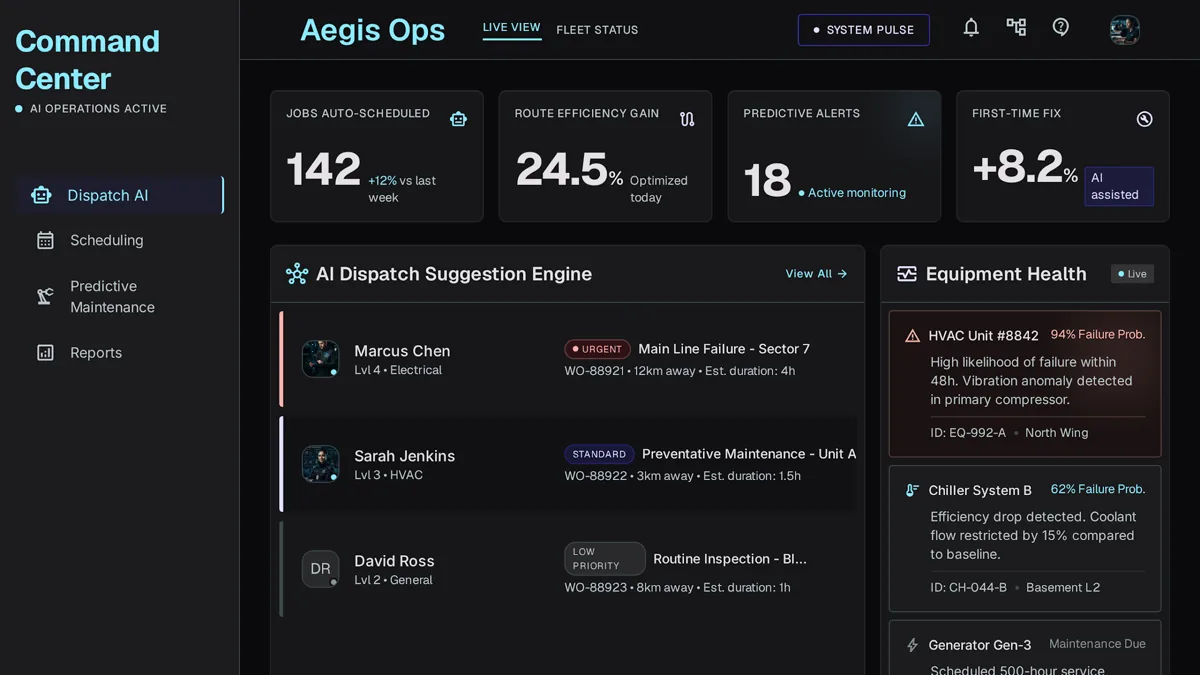
Most field service AI comes bundled into an enterprise platform priced for national franchises. We build focused AI features — smarter dispatching or predictive equipment alerts — sized and priced for a regional service company.

Not every AI feature is worth building. These are the ones with a measurable return.
AI-optimized dispatching matches the right technician to the right job based on skill, location, and urgency.
Predictive alerts flag equipment likely to fail before it triggers an emergency service call.
Real-time dispatch adjustments account for traffic, cancellations, and job overruns automatically.
AI features integrate with your current field service software instead of replacing it.
No enterprise minimums or per-technician SaaS fees that don't make sense at your scale.
Dispatch and maintenance models are built on your job history and stay under your control.
Pick the ones that match where the manual work actually is.
Matches technicians to jobs based on skill, proximity, and schedule in real time.
Flags equipment showing early signs of failure based on service history and sensor data.
AI-generated estimates based on job type, parts, and historical labor time.
Proactive arrival-window updates instead of reactive 'where's my technician' calls.
Tracks completion time, first-time fix rate, and callback frequency by technician.
Tracks dispatch efficiency, alert accuracy, and response time in one place.
No. We build AI features that integrate with your existing field service software rather than requiring a platform switch.
Off-the-shelf field service platforms bundle AI into their broader enterprise suite at a price point built for large franchises. We build focused, standalone AI features sized for regional operators who don't need the full platform.
Accuracy improves with more service history, but even directional alerts — flagging equipment as higher-risk — reduce emergency calls when technicians act on them proactively.
A focused feature like dispatch optimization or maintenance alerts usually launches in 5-8 weeks.
Tell us where the manual work actually is — dispatching or maintenance planning — and we'll scope a focused AI feature.