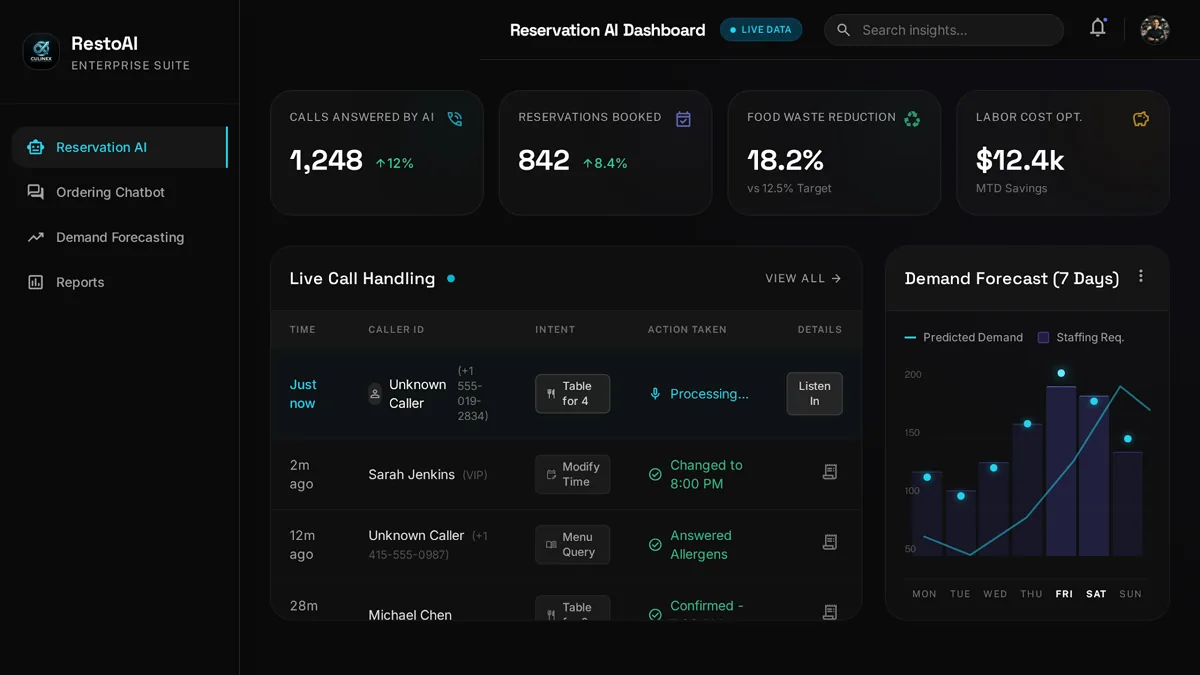
Most restaurant AI comes bundled into a POS platform's enterprise tier. We build focused AI features — AI-handled reservation calls or demand forecasting for staffing and purchasing — sized and priced for a multi-location group.

Not every AI feature is worth building. These are the ones with a measurable return.
AI answers and books reservation calls during peak hours instead of sending them to voicemail.
Demand forecasting predicts covers by day and shift so managers schedule staff ahead of time.
Purchasing forecasts based on predicted demand cut over-ordering on perishables.
AI features integrate with your current POS and reservation system instead of replacing them.
No enterprise minimums or per-location SaaS fees that don't make sense at your scale.
Forecasting and call-handling models are built on your sales and reservation data and stay under your control.
Pick the ones that match where the manual work actually is.
Answers calls, books tables, and handles common questions without a host picking up the phone.
Predicts covers and sales volume by day and shift to guide staffing and prep.
Recommends order quantities for perishables based on predicted demand and waste history.
Sends table-ready texts and manages the waitlist without staff manually calling names.
Flags underperforming or high-margin items based on sales and prep cost data.
Tracks call handling rate, forecast accuracy, and waste reduction across locations.
No. We build AI features that integrate with your existing POS and reservation system rather than requiring a platform switch.
Mainstream POS platforms bundle AI into their broader suite at a price point tied to their hardware and platform tier. We build focused reservation and forecasting features sized for groups that want targeted AI without switching their whole POS.
Accuracy depends on historical sales data quality, but even a directional forecast — accurate within 10-15% — is usually enough to improve staffing and purchasing decisions.
A focused feature like reservation handling or demand forecasting usually launches in 5-8 weeks.
Tell us where the manual work actually is — reservations or forecasting — and we'll scope a focused AI feature.