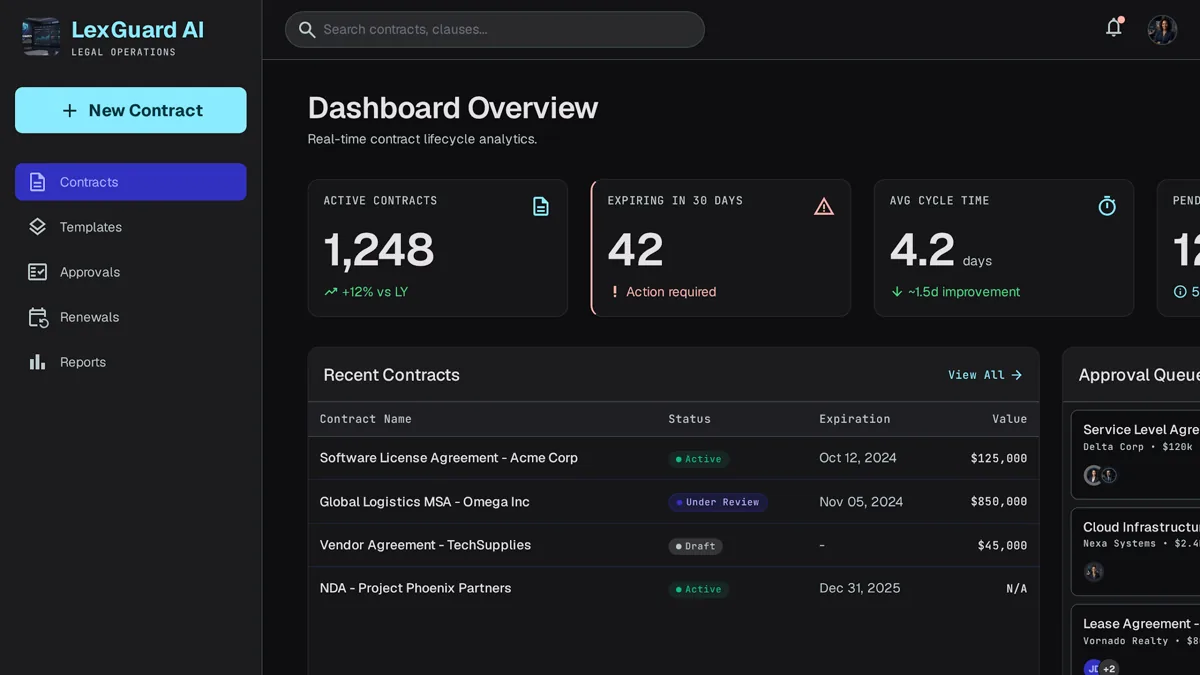
Generic contract tools force your approval chain, renewal cadence, and templates into someone else's workflow. We build contract management software around how your legal, sales, and procurement teams actually review, approve, and track agreements — from first draft to renewal.

Generic CLM platforms cover the basics. Custom contract management software removes the workarounds your legal and ops teams have learned to live with.
Expiration and renewal dates are tracked automatically with escalating reminders, instead of living in someone's calendar or a spreadsheet.
Contracts route to the right approvers by value, department, or contract type — not a generic one-size-fits-all chain.
Clause libraries and approved templates keep every contract consistent without legal reviewing the same boilerplate twice.
Drafting, redlines, approvals, signatures, and renewals live in one pipeline instead of scattered across email and shared drives.
No per-seat pricing that punishes growth, and no vendor lock-in when you need a workflow step they don't support.
Contract value by status, average cycle time, and upcoming renewals — built around the numbers you already track manually.
We build the modules your team needs — not a bloated suite of features you'll never touch.
Searchable list of every contract with status, owner, value, and expiration date at a glance.
Approved templates and clause blocks so new contracts start from a compliant baseline.
Multi-step approval routing by contract type or value, with a clear pending-approvals queue.
Automatic alerts before expiration, with configurable notice periods per contract type.
Active contracts, expiring-soon counts, cycle time, and pending approvals in one view.
Full history of edits, approvals, and signature events for every contract.
Yes. Drafting from templates, redline tracking, and multi-step approval routing live in the same pipeline, so legal and business owners see a single contract queue instead of switching between tools.
We build routing around your actual approval chain — a low-value vendor contract might need one sign-off, while a high-value agreement routes through legal, finance, and an executive. Rules are configurable per contract type or value threshold.
Subscription CLM platforms cost less upfront but charge per seat indefinitely and cap what you can customize. A custom build has a higher initial cost but no recurring per-user fees and grows with workflow steps you actually request.
For teams whose approval chains, templates, or reporting needs don't fit those platforms' assumptions, a custom build removes the workarounds without paying for modules you don't use.
Tell us how your contracts get drafted, approved, and renewed today — we'll scope a system that fits, not one you have to adapt to.