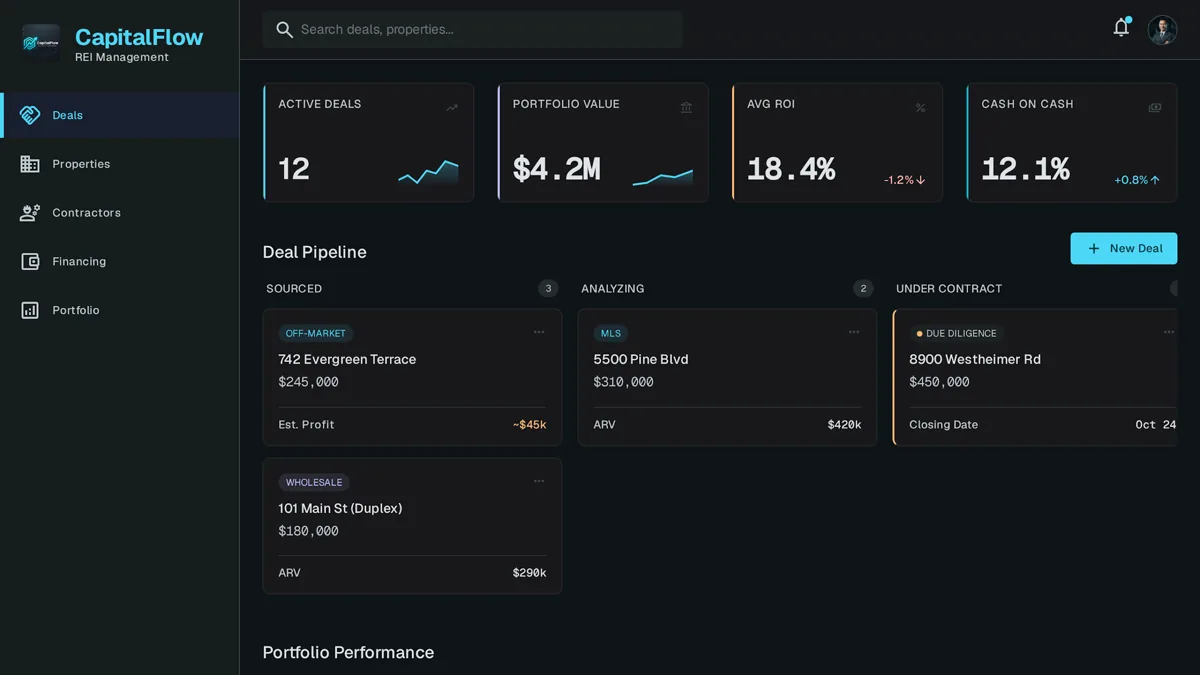
Retail real estate CRMs assume you're selling to homebuyers, not sourcing deals, managing rehab budgets, and tracking portfolio ROI. We build a system around the actual lifecycle of an investment property — from the first cold list to the exit.

Retail-focused CRMs don't model acquisition, rehab, or hold-period economics. A custom build tracks the numbers that actually drive your returns.
Sourced, Analyzing, Under Contract, Rehab, Listed — deal stages that match how you actually underwrite and close, not a buyer-agent sales funnel.
Portfolio table showing purchase price, rehab spend, current value, and ROI per property, so you're not rebuilding the math in a spreadsheet every month.
Contractor bids, draws, and change orders logged against the original scope, so cost overruns show up before they blow the deal's margin.
Every off-market lead, wholesaler tip, and driving-for-dollars find gets tracked with follow-up cadence, instead of living in a notes app.
Active deals, held properties, and exited deals in one system — no reconciling three spreadsheets to know your actual exposure.
Add acquisition managers, asset managers, and contractors to the system without a subscription bill that punishes your growth.
We build the modules your firm needs to run deal flow and portfolio management — not a generic sales CRM with real estate branding.
Sourced through Analyzing, Under Contract, Rehab, and Listed, with underwriting numbers attached at every stage.
Live table of held and exited properties with purchase price, rehab cost, current value, and ROI, sortable by any metric.
Scope, bids, draws, and change orders tracked per property against the original rehab budget.
Off-market leads, wholesaler submissions, and direct mail responses tracked with follow-up cadence and source attribution.
Quick comp pulls and deal underwriting calculators built into the deal record itself.
Automated reports for capital partners and lenders showing portfolio performance without manual spreadsheet work.
Yes. Deals can be tagged by strategy, and the portfolio table tracks flips through to sale and rentals through ongoing hold-period performance, all in the same system.
Contractors or project managers log draws and change orders against line items in the original scope, so you see budget-to-actual variance per property instead of finding out at the final invoice.
Generic CRMs charge a flat monthly fee but don't model acquisition underwriting or rehab budgets, so teams end up paying for a CRM and a separate spreadsheet system anyway. A custom build costs more upfront but replaces both, with no per-seat fee as you add acquisition or asset management staff.
Those platforms are built for retail agents managing buyer and seller leads, not acquisition pipelines or portfolio ROI. A custom CRM models your actual deal stages and hold-period math instead of forcing investment activity into a residential sales pipeline.
Tell us how you source, underwrite, and track your portfolio today — we'll scope a system built around your deal flow.