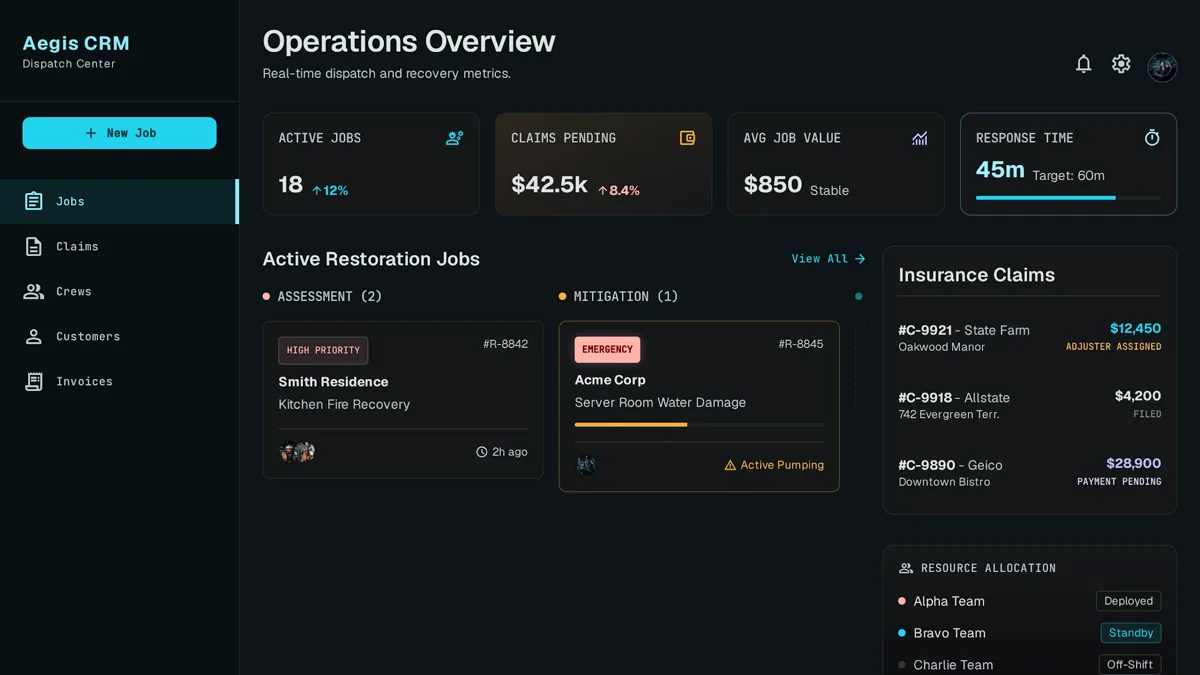
Fire and water damage jobs live and die by insurance claim status, not a generic sales pipeline. We build a CRM around your actual project phases and the claim paperwork that determines when you get paid.

Off-the-shelf tools track jobs. They don't track claim numbers, adjuster contacts, or the phase-by-phase documentation insurers demand.
Mitigation, demo, drying, reconstruction, closeout — whatever phases your crews actually run through, tracked as a board instead of a flat job list.
Claim number, adjuster contact, approved scope, and payment status live on the project record, not in a separate binder or shared drive folder.
Photos, moisture readings, and equipment logs attached to the right phase and claim, so you're not scrambling to rebuild a file when an adjuster pushes back.
Automatic reminders when a claim is waiting on approval, documentation, or payment, so nothing sits untouched for weeks.
See which crews and drying equipment are deployed where, so scheduling the next job doesn't mean calling around to check availability.
Add project managers, techs, and office staff without a subscription bill that scales against you.
We build the modules your business needs to run jobs and claims together — not a generic job tracker with a restoration label.
Active jobs tracked through mitigation, demo, drying, reconstruction, and closeout, with phase-specific checklists.
Claim number, carrier, adjuster contact, approved scope, and payment status tied directly to each project.
Timestamped photos, moisture readings, and equipment logs organized by phase for claim substantiation.
Live view of which drying equipment and crews are assigned to which active jobs.
Line-item scope building that aligns with how carriers expect claims to be itemized.
Alerts when a claim is awaiting adjuster approval, supplement, or final payment.
They're linked but distinct — the claim record holds carrier, adjuster, and payment status, while the project board tracks physical progress through phases. Either can move independently, which matches how claims and fieldwork actually progress.
Photos, moisture logs, and equipment records are timestamped and tied to the specific phase and claim, so if an adjuster disputes scope or drying time, you can pull a complete file instead of reconstructing one from memory.
Off-the-shelf restoration documentation platforms charge recurring subscription fees and cover documentation reasonably well, but many don't fully integrate claim financials with phase-based project management the way a custom system can. A custom build costs more upfront but removes the gap between your documentation tool and your job tracker.
For companies that need claim tracking, phase management, and crew scheduling in one system rather than stitching together a documentation app and a separate CRM, a custom build consolidates that into one source of truth without paying for two subscriptions.
Tell us how you track jobs and claims today — we'll scope a system that keeps phases and paperwork in sync.