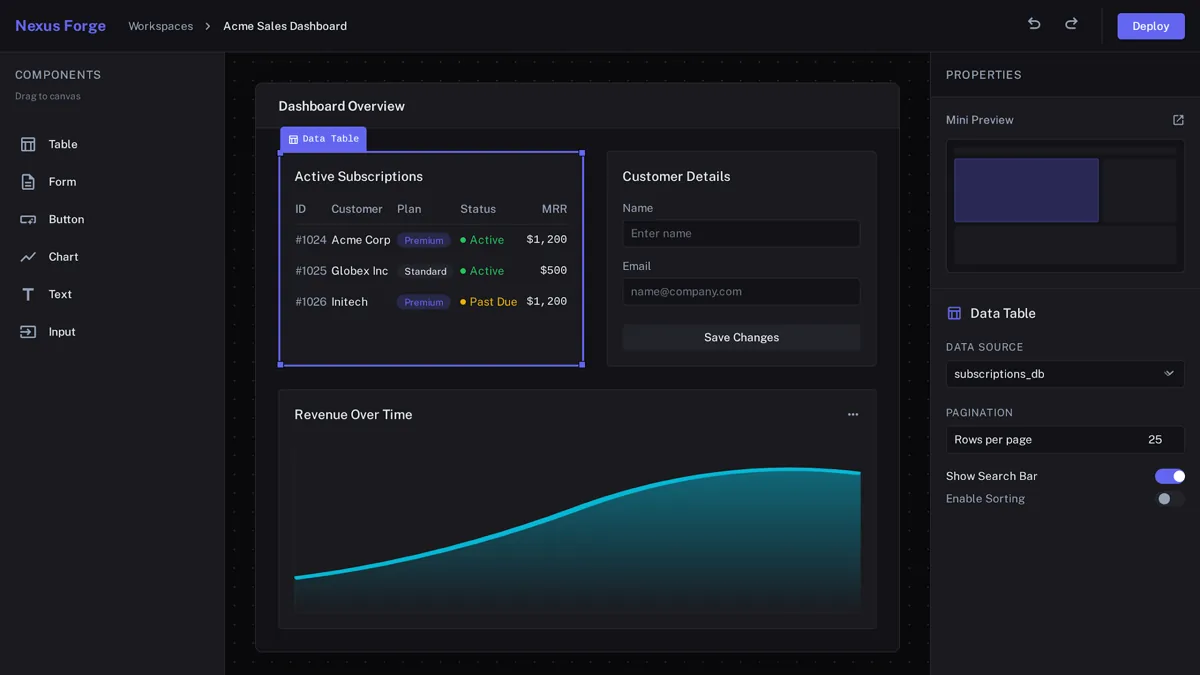
Low-code builders get you 80% of the way there and then hit a wall on permissions, integrations, or performance. We build internal tools around your actual data, workflows, and team structure — with no plan limits.

Low-code builders work until your permissions, scale, or integration needs outgrow their plan.
Build as many internal apps as your team needs without paying more per editor, viewer, or workspace.
You own the code and infrastructure instead of depending on a vendor's uptime and roadmap for tools your operations run on.
Built to handle your actual data volume instead of slowing down once tables grow past what a low-code platform handles well.
Row- and field-level access rules modeled on your actual teams and approval chains, not a generic role template.
Connects directly to your databases, APIs, and internal services instead of working through a limited connector library.
Add new workflows, tables, or automations without waiting on a platform vendor's feature request queue.
We build the modules your operations need.
Drag-and-drop canvas for assembling internal apps from tables, forms, and components.
Editable, filterable data grids connected directly to your production database or APIs.
Custom forms with validation, approval steps, and automated actions triggered on submission.
Access control down to the row or field level, matched to your team's actual structure.
Direct connections to your existing databases, internal services, and third-party APIs.
Full history of who changed what, when — critical for tools that touch sensitive operational data.
Low-code internal tools builders are strong for quick internal prototypes. A custom build makes sense once you hit their scaling limits, need permissions or integrations they don't support, or want to avoid ongoing per-seat costs as your team grows.
Yes. We build direct, read/write connections to your existing databases and APIs rather than requiring data syncs or exports.
We build row- and field-level permissions and full audit logging so sensitive operational data is only visible to the people who should see it.
A focused internal tools MVP — a handful of core workflows and data views — usually takes 5-7 weeks depending on integration complexity.
Tell us about your workflows, data sources, and team structure — we'll scope an internal tools platform that fits.