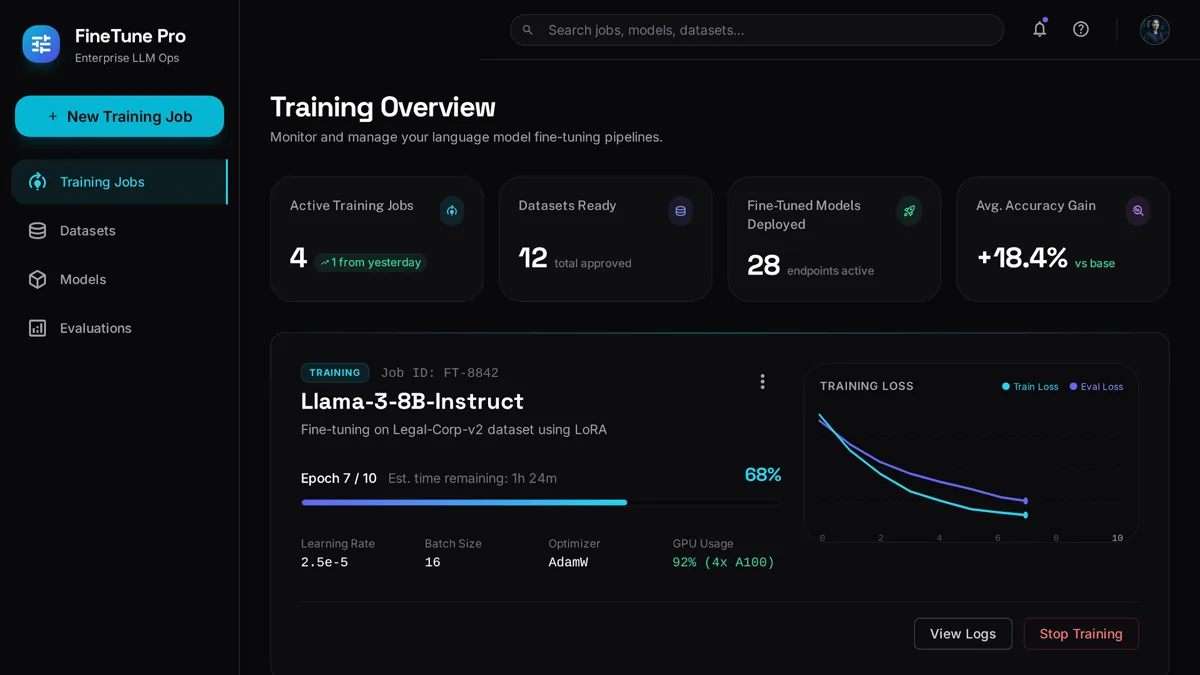
Prompt engineering has a ceiling. When a general-purpose model keeps missing your formatting, tone, or domain-specific logic no matter how the prompt is worded, fine-tuning on your own data is what closes the gap. We handle data prep, training, and evaluation so the result is measurably more accurate, not just different.

Fine-tuning solves problems that better prompts can't.
Learns your exact structure and tone instead of drifting across responses.
Behavior baked into the model means shorter prompts and lower per-call cost at scale.
Learns patterns from your own examples that a generic model wasn't trained on.
Reduces the variance you get from prompt-only approaches across thousands of requests.
We clean, structure, and validate training examples so the model learns from good data.
Evaluated against a held-out test set before it ever reaches production traffic.
A structured process from raw data to a validated, deployed model.
Turning your existing content, transcripts, or records into structured training examples.
Configured for your chosen base model and provider, with the right hyperparameters for your dataset size.
Tracked across epochs to catch overfitting or underfitting before it wastes a training run.
Testing on data the model never saw during training, measured against clear success criteria.
Fine-tuned model output compared directly against the base model and prompt-only baseline.
Rolled into your product with usage and quality monitoring after launch.
Model providers' fine-tuning docs and generic fine-tuning platforms give you the training infrastructure, but the hard part is data prep, hyperparameter choices, and evaluation — get those wrong and you get a model that's worse than the base, not better. We handle that full pipeline, not just the training job.
It depends on the task, but most useful fine-tunes start with a few hundred to a few thousand well-structured examples. We'll assess your existing data during scoping and tell you honestly if there isn't enough yet.
Fine-tuning improves consistency, tone, and task-specific accuracy, but it isn't a fix for factual grounding — for that, we'd typically pair it with retrieval against your actual source data.
We evaluate it against a held-out test set and the prompt-only baseline before rollout, so the improvement is measured, not assumed.
Tell us where prompting alone is falling short — we'll scope a fine-tuning project with a clear before/after benchmark.