Smerdoff
Smerdoff / AI Development

Custom Predictive Analytics Development

Spreadsheet trendlines and generic BI forecasts break down the moment your business has real seasonality, external drivers, or irregular patterns. We build predictive models trained on your own historical data — with confidence intervals attached, so you know how much to trust the number, not just what it is.

Custom Forecasting ModelsConfidence IntervalsTrained on Your HistoryBusiness-Ready Output
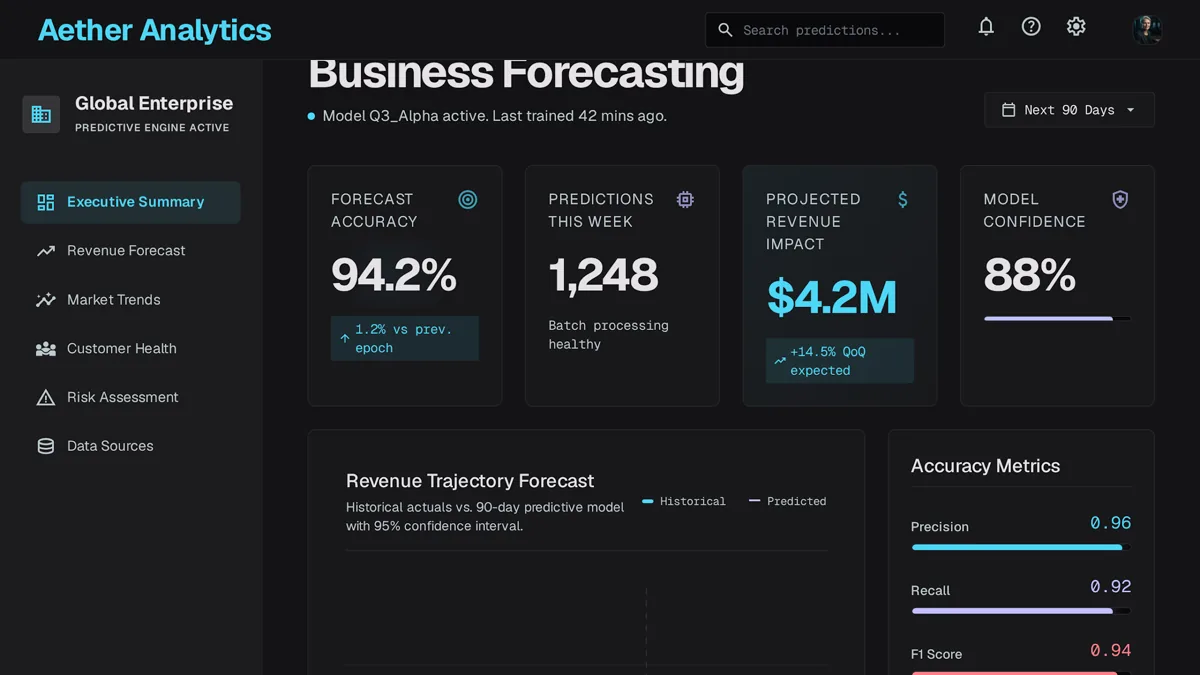
Forecast chart showing predicted values over time with a shaded confidence interval band
65%
of support queries are now resolved without a human — up from 52% in 2023
LiveChatAI
21×
more likely a lead qualifies when contacted within 5 minutes — AI replies instantly
MIT / InsideSales

Why a custom model beats a generic forecasting tool

Generic forecasting tools assume generic patterns. Your business rarely follows one.

Trained on your actual history

Learns from your real sales, usage, or operations data, not a generic industry curve.

Confidence intervals, not false precision

Every forecast comes with a range showing how much uncertainty to expect, not a single misleadingly exact number.

Accounts for your specific drivers

Seasonality, promotions, external events — modeled as factors instead of ignored as noise.

Built for the decision it supports

Modeled around the actual business question — inventory, staffing, churn risk — not a generic metric.

Integrates into your workflow

Feeds forecasts into your existing dashboards or planning tools instead of a static report.

Retrained as data grows

Designed to be updated as new data comes in, so accuracy improves rather than decays.

What goes into a predictive analytics build

A model built around your specific forecasting question, evaluated before it's trusted.

Data preparation

Cleaning and structuring your historical data so the model learns from signal, not noise.

Model selection and training

Choosing and training the right approach for your data — time series, regression, or classification.

Confidence interval calculation

Every prediction paired with a range reflecting actual model uncertainty.

Backtesting against history

Validated against past periods to measure real accuracy before it's used for decisions.

Forecast dashboard

Visualizes predictions against actuals with confidence bands, updated as new data arrives.

Retraining pipeline

Set up so the model updates on a schedule instead of going stale after launch.

FAQ

Automated ML platforms are strong options if your team wants to manage modeling in-house through a licensed tool. We build a custom model tailored to your specific business question and integrate the output directly into your existing systems, without the platform license or the generalist assumptions of an automated pipeline.

It depends on your data and the volatility of what you're predicting. We backtest against your historical data before rollout so you see real accuracy numbers, not a marketing claim, and every forecast ships with a confidence interval.

Demand and sales forecasting, churn risk scoring, inventory needs, staffing levels, or custom risk models — anything with enough historical data to learn from.

It varies by use case, but most forecasting models need at least a couple of years of relevant history, or enough cycles to capture seasonality. We'll assess this honestly during scoping.

Related

Get a free estimate for your predictive analytics project

Tell us what you're trying to forecast and what data you have — we'll scope a model built for that specific question.