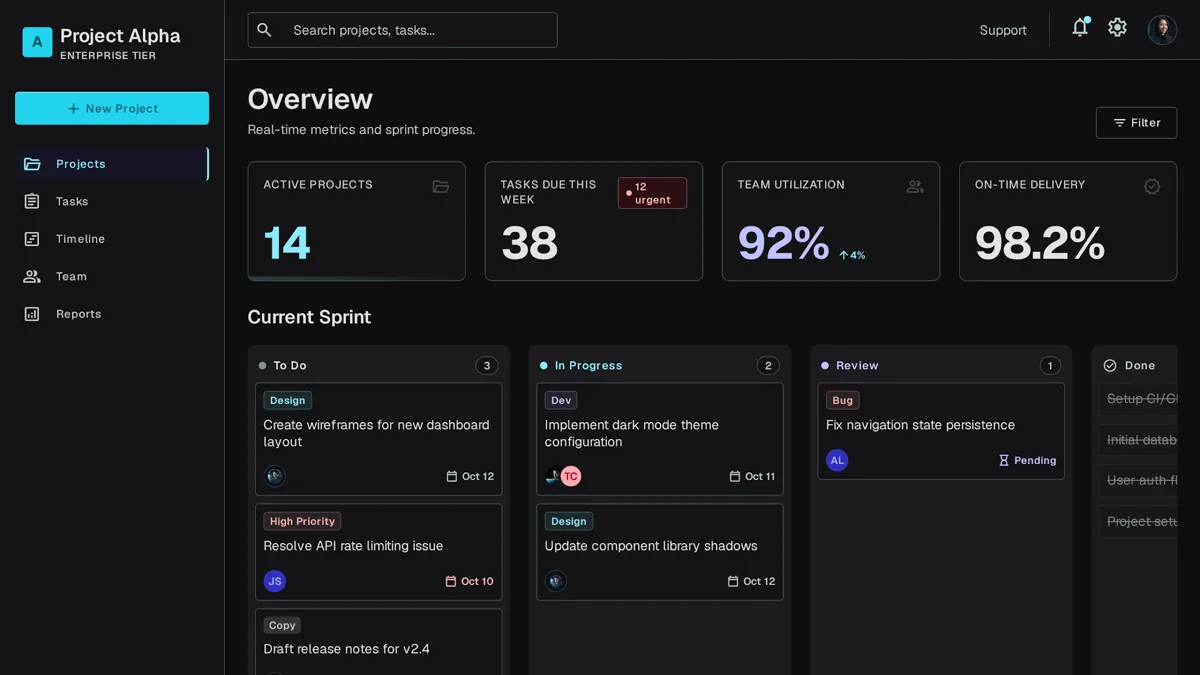
Mainstream subscription PM tools are built to serve every team on earth, which means yours ends up bending to fit their model. We build project management software around your process, your fields, and your reporting — not the other way around.

Generic PM tools work for generic workflows. Yours stopped being generic a while ago.
Custom statuses, approval chains, and task types modeled on how your team actually moves work — not a board template you had to work around.
Team velocity, workload, and project health reported the way your leadership actually reads them, not a generic dashboard widget.
Add teams and contractors without recalculating your software budget every quarter.
Time tracking, invoicing, CRM, or internal tools live in the same data model instead of three tabs and manual syncing.
Sprints, phases, retainers, or milestone billing — whichever model your business runs on, not whichever the tool assumes.
Add a new project type, field, or automation the week you need it, not the quarter the vendor gets to it.
We build the modules your team actually uses.
Custom columns, swimlanes, and statuses that match your actual workflow stages.
Dependencies, milestones, and resource scheduling visible at the project and portfolio level.
Velocity, utilization, and burn-down reporting tuned to how your team plans work.
Status changes, approvals, and notifications triggered by rules specific to your process.
Limited-access views so clients or stakeholders see progress without touching internal fields.
Connections to time tracking, invoicing, Slack, or your existing internal tools.
For a generic task list, they're fine. Teams move to custom software when they're paying for seats they don't need, working around fields the tool doesn't support, or needing metrics and integrations the platform can't provide. If your process still fits a generic board, stick with the SaaS tool — we'll tell you that in a discovery call if it's true.
Usually, yes. Most teams running custom PM software also replace a separate time-tracking tool, a reporting spreadsheet, and sometimes a client-facing status page, since all three can live in one system.
Yes. We build import tooling for your current tasks, comments, and attachments so your team isn't starting from zero on launch day.
Yes. Different project types can have different fields, workflows, and views within the same system, so engineering, marketing, and client services don't have to share one rigid template.
A focused MVP — boards, timelines, and core reporting — usually takes 6-8 weeks depending on integrations and how many project types you need to support.
Tell us how your team plans and tracks work — we'll scope a system built around your actual process instead of a generic template.