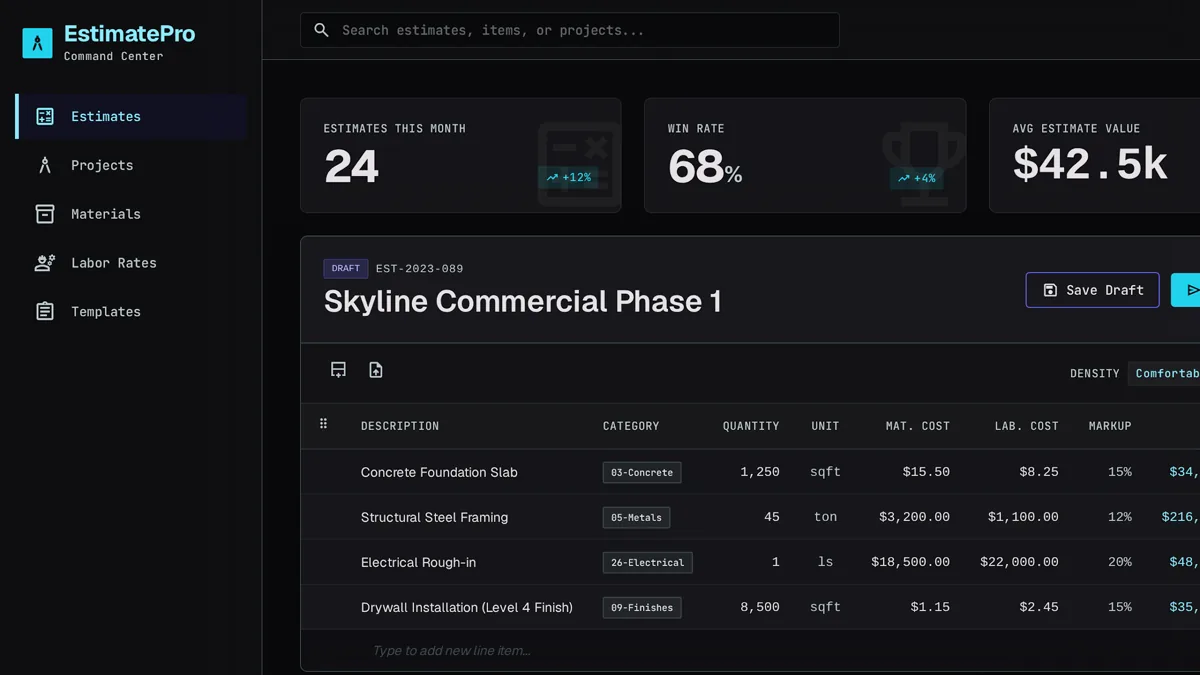
Generic estimating tools ship with someone else's cost database, someone else's markup logic, and templates that never quite match your trade. We build estimating software around your actual price book — from the first line item to the bid you send the client.

Spreadsheets and generic estimating apps get a growing contractor to a point — then start costing bids. A custom build removes the ceiling.
Materials and labor rates reflect your actual suppliers and crews, not a national average that's wrong for your market.
Markup and margin rules are built into the estimate builder, so pricing doesn't drift depending on who wrote the bid.
Start a new estimate from a template that already has the right line items for that job type, then adjust instead of rebuilding from scratch.
Track estimates sent, win rate, and average estimate value so you know which jobs and pricing actually convert.
A won estimate becomes a project with its budget already loaded — no retyping line items into a separate tool.
Add a new cost category, a new markup tier, or a new report whenever your business needs it, without waiting on a vendor roadmap.
We build the modules your estimating process needs — not a bloated suite you'll only use a third of.
Build estimates with material, labor, and markup columns per line item, rolling up to a running total.
A maintained price book of materials and labor rates that estimators pull from instead of retyping costs.
Reusable templates for common project types, so estimators start from the right structure every time.
Configurable markup logic applied consistently across materials, labor, and subcontractor costs.
Won estimates convert directly into projects with the budget and line items already in place.
Estimates sent this month, win rate, and average estimate value tracked automatically instead of tallied by hand.
Yes. We typically migrate your current materials and labor cost data during setup, so estimators aren't starting from a blank rate library on day one.
We build configurable markup rules — flat percentage, tiered by cost category, or job-type specific — so pricing stays consistent without an estimator needing to calculate it manually on every line item.
Subscription estimating tools have a lower entry price but charge per user and cap how much you can adapt the cost database or markup logic. A custom build costs more upfront but has no recurring per-seat fees and can be extended as your business grows.
For contractors whose price book, markup rules, or reporting needs no longer fit a generic platform's assumptions, a custom build removes the workarounds and gives you a system that matches how your estimators actually price jobs.
Tell us how your team prices jobs today — we'll scope a system built around your price book and markup rules, not a generic template.