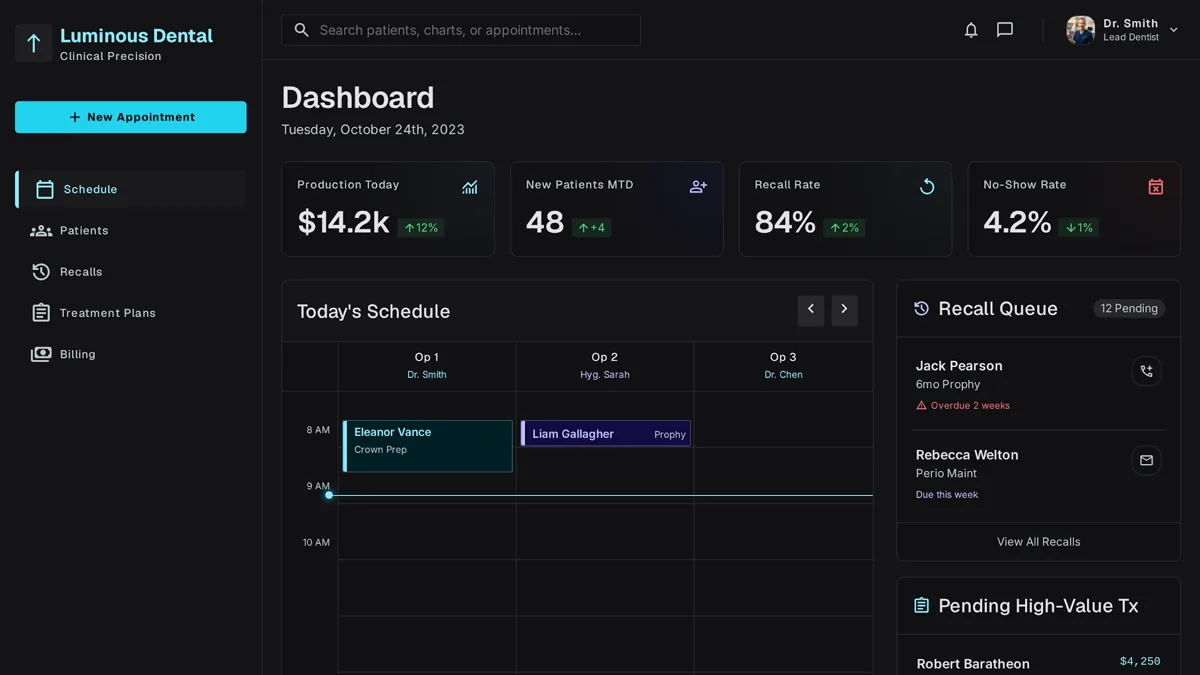
Off-the-shelf dental software forces your operatory scheduling, recall program, and treatment follow-up into a rigid template. We build a CRM around how your practice actually fills chairs and closes treatment plans — not a generic system built for every practice at once.

Most dental software was built to check every box for every kind of practice, which means it fits none of them precisely. A custom CRM removes the workarounds your front desk and hygienists have learned to live with.
Book by chair, hygienist, and doctor availability at once — not a generic calendar that ignores which operatory is actually free.
Patients due for a cleaning, a follow-up, or a lapsed treatment plan surface automatically instead of relying on someone checking a list by hand.
Diagnosed but unscheduled work — a crown, a filling, an implant consult — tracked and followed up on, instead of quietly falling off after the visit ends.
Automated reminders and easy rebooking reduce the empty chair time that hurts a dental schedule the most.
Appointment type, insurance verification, and payment status connected — no re-entering the same patient data across tools.
Production by provider, treatment acceptance rate, and recall conversion — the numbers that actually predict practice revenue.
We build the modules your practice needs — not a bloated suite built for a hospital dental department.
Chair-aware booking with hygienist and doctor availability, plus automated confirmations.
Automatic surfacing of patients due for cleanings, follow-ups, or lapsed treatment plans.
Diagnosed but unbooked work tracked per patient, with follow-up reminders for the front desk.
Full treatment and visit history in one record, visible to any provider covering a chair.
Automated text/email reminders with one-tap rebooking to reduce no-shows.
Appointment-level billing tied to insurance verification and payment status, cutting front desk back-and-forth.
Yes. Scheduling accounts for chair availability, hygienist schedules, and doctor time together, so the front desk isn't double-booking a chair that's actually occupied or missing hygienist availability that a generic calendar doesn't track.
Diagnosed but unbooked treatment — a crown, a filling, an implant referral — is tracked against the patient record with follow-up reminders, instead of relying on the front desk to remember to call before it falls off the radar.
Recall intervals can be set per patient or per treatment type — six-month cleanings, three-month periodontal maintenance, annual X-rays — so the queue reflects your actual clinical protocol, not a single fixed interval.
Established dental practice management platforms are a reasonable choice if your scheduling and recall process fit their model. If you run a specific recall protocol, unusual operatory setup, or need reporting they don't offer, a custom build removes those limits — at a higher upfront cost but no per-provider licensing fees.
Tell us how your practice schedules chairs and tracks recall today — we'll scope a system that fits your process, not one you have to adapt to.