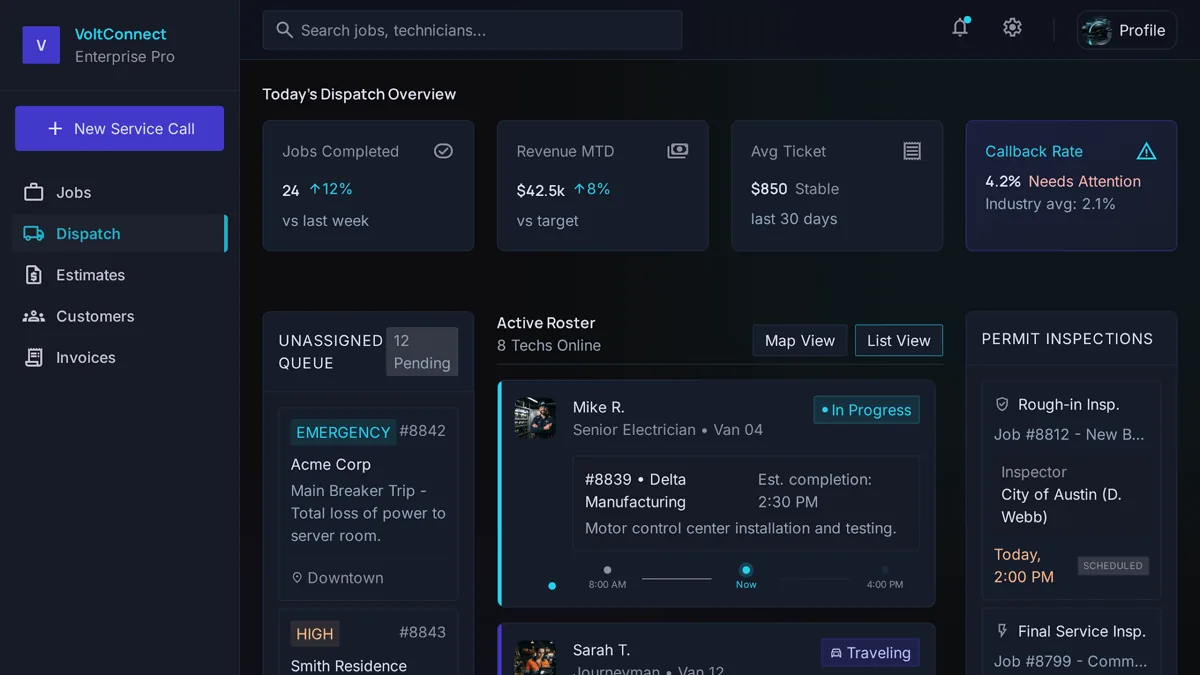
Off-the-shelf field service software forces your dispatch, permits, and inspections into someone else's workflow. We build a CRM around how your crew actually moves a job from service call to signed-off inspection.

Generic field service tools treat every trade the same. A custom CRM handles the permit and inspection steps that make electrical work different from a typical service call.
Permit status and inspection scheduling are tracked as part of the job, not a side process someone has to remember to follow up on.
Assign jobs by technician license level, service area, and current load — not a generic scheduling algorithm that ignores who's actually qualified for the work.
Quoted, scheduled, in progress, awaiting inspection, closed — every job's real stage, visible without a phone call to the field.
Quotes convert into jobs, and change orders during a job update the invoice automatically — no re-entering data across separate tools.
No per-technician pricing that punishes growth, and no vendor lock-in when you need a feature they don't offer.
Revenue by technician, job type, and callback rate — built around the numbers you already track manually.
We build the modules your business needs — not a bloated suite of features you'll never touch.
Drag-and-drop job assignment by technician license, location, and current load, with emergency calls flagged.
Every job's real stage — quoted, scheduled, in progress, awaiting inspection, closed — visible to office and field.
Permit application status and inspection scheduling tied directly to the job, with reminders before deadlines slip.
Line-item quotes that convert into scheduled jobs, with change orders updating the invoice automatically.
Mobile view for techs to see job details, update status, and capture photos or signatures on-site.
Full service and inspection history per property, so any technician has context before arriving.
Yes. Permit applications and inspection dates are tracked as part of the job record, with reminders before a deadline slips, so a job doesn't sit stalled because no one remembered to follow up with the city.
Jobs can be assigned based on technician license level and qualification, not just availability, so a dispatcher isn't sending an apprentice to a job that legally requires a licensed electrician.
One-off service calls and multi-week installation projects run through the same job pipeline, with different stages and milestones as needed, so the office isn't switching between separate tools for different job types.
Mainstream field service platforms are strong options if your permit process, dispatch rules, and reporting fit their standard model. If your workflow has specific licensing requirements, unusual job structures, or needs reporting they don't support, a custom build removes those workarounds — at a higher upfront cost but no recurring per-technician fees.
Tell us how your dispatch, permits, and inspections work today — we'll scope a system that fits, not one you have to adapt to.